Fashion-inspired wedding photography in Paris is not about making a wedding look like a runway show. It is about applying a fashion photographer’s way of seeing to a wedding day. The attention to cut, to fabric in motion, to the relationship between a body and the space it moves through. Paris is where this becomes possible in ways it simply is not elsewhere. The city was built for exactly this kind of looking.
What Fashion-Inspired Wedding Photography in Paris Actually Means
Furthermore, in traditional wedding reportage, the camera follows the day as it unfolds. In fashion-inspired wedding photography in Paris, there is a second layer of attention. One borrowed from editorial work — that asks not just what is happening, but how it is happening. How the weight of a couture gown changes the way someone walks. A silk hem catches the light differently at different speeds. How a tuxedo jacket reads against rough stone versus polished marble. These are not the questions a documentary approach asks. They are the questions a fashion photographer asks instinctively.
Additionally, for couples who have invested in their dress or suit. Who have thought seriously about what they are wearing — this approach ensures that the photography reflects that investment. The clothes become part of the story, not merely the backdrop to it.
Reading Fabric as a Photographer
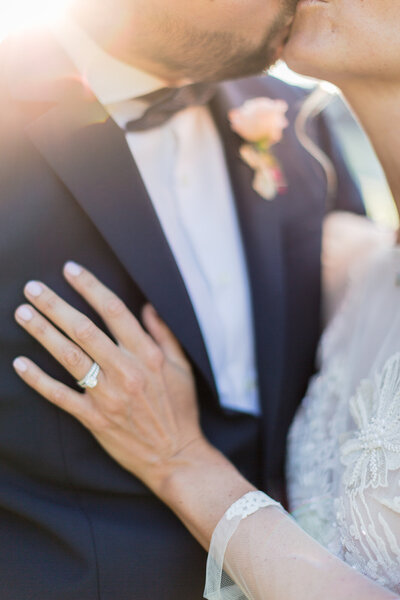
Notably, every fabric has a different relationship with light. Silk is specular — it reflects directly, creating highlights that move as the dress moves. Organza is translucent — backlight turns it luminous in a way that no other material matches. Lace has texture that only becomes visible when the light hits it at an angle. Velvet absorbs light and reads as depth rather than surface.
Moreover, understanding this changes how I position myself relative to the light source, and when I make the exposure. For a bride in a silk gown on the staircase of the Shangri-La. I want the light coming from slightly behind and to the side. So the movement of the fabric creates its own shaping. For lace in the gardens of the Musée Rodin. I want the late afternoon sun at a low angle, raking across the surface. These are decisions that happen before the shutter opens. And they are the difference between a photograph of a wedding dress and a photograph of the person wearing it.
Paris as a Fashion Stage
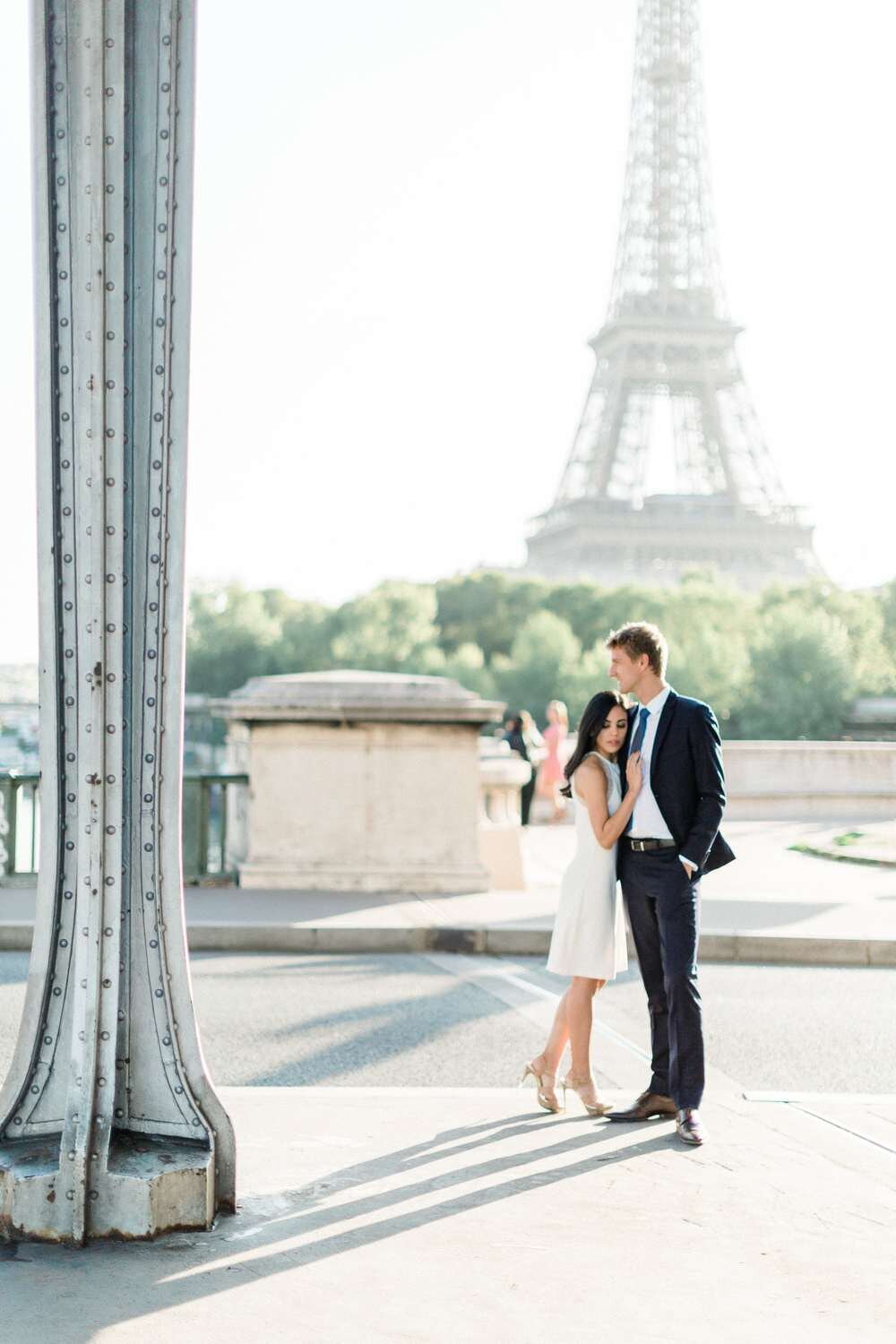
Indeed, the city has a particular quality that fashion photographers have known about for a long time. Its architecture creates frames within frames. The colonnaded arcades of the Palais Royal, the iron grids of the grand hotel balconies, the tall Haussmann windows. All of these divide space in ways that give structure to an image without requiring the photographer to impose it. A figure in a couture gown, standing in the archway of the Hôtel de Crillon, is already in a composition. The building has done most of the work.
In particular, beyond the grand hotels, Paris has smaller spaces that reward an editorial approach. The covered passages of the 2nd arrondissement, with their glass roofs and 19th-century ironwork. Equally, the formal gardens of the Palais Royal offer a different geometry — gravel paths that create natural leading lines. The riverside quais at blue hour. When the stone walls and the water surface both carry the last of the ambient light. These are not the locations that appear in most wedding portfolios. That is precisely why they work.
Direction Without Staging
Beyond this, the approach I use for fashion-inspired wedding photography in Paris sits between pure reportage and full direction. I am not creating scenarios — I am creating conditions. Asking you to walk slowly along a colonnade so that your gown moves rather than stays still. Suggesting a particular angle so that the light reaches your face the way it should. Giving you something specific to think about. A direction to look, a pace to keep — so that your body forgets it is being photographed.
Equally, the result looks spontaneous because the preparation is invisible. The editorial quality comes not from posing but from attention — from noticing the right moment rather than constructing it. Notably, the best fashion-inspired wedding images often happen in the transitions. Between the ceremony and the reception, between the room and the corridor, between one thing and the next.
On Format: Film and the Fashion Aesthetic
That said, fashion photography has a long history with film. And for couples drawn to a couture aesthetic, it is worth considering whether film might form part of the coverage. Film renders fabric differently from digital. The grain sits in the highlights rather than the shadows. And the tonal curve gives whites a particular quality that reads as more tactile, more physical. It is not always the right choice, and it is not always available in every shooting condition. However, for couples who are thinking seriously about the visual language of their images, it is a conversation worth having.
More on the choice between film and digital is explored in the article on film versus digital Paris wedding photography.
For couples considering how the season will affect both the light and the visual character of their images, the article on seasonal Paris weddings covers this in detail.
Your wedding is a singular story. I would love to hear it.







LEAVE A COMMENT