Paris is not a backdrop. It is a composition partner.
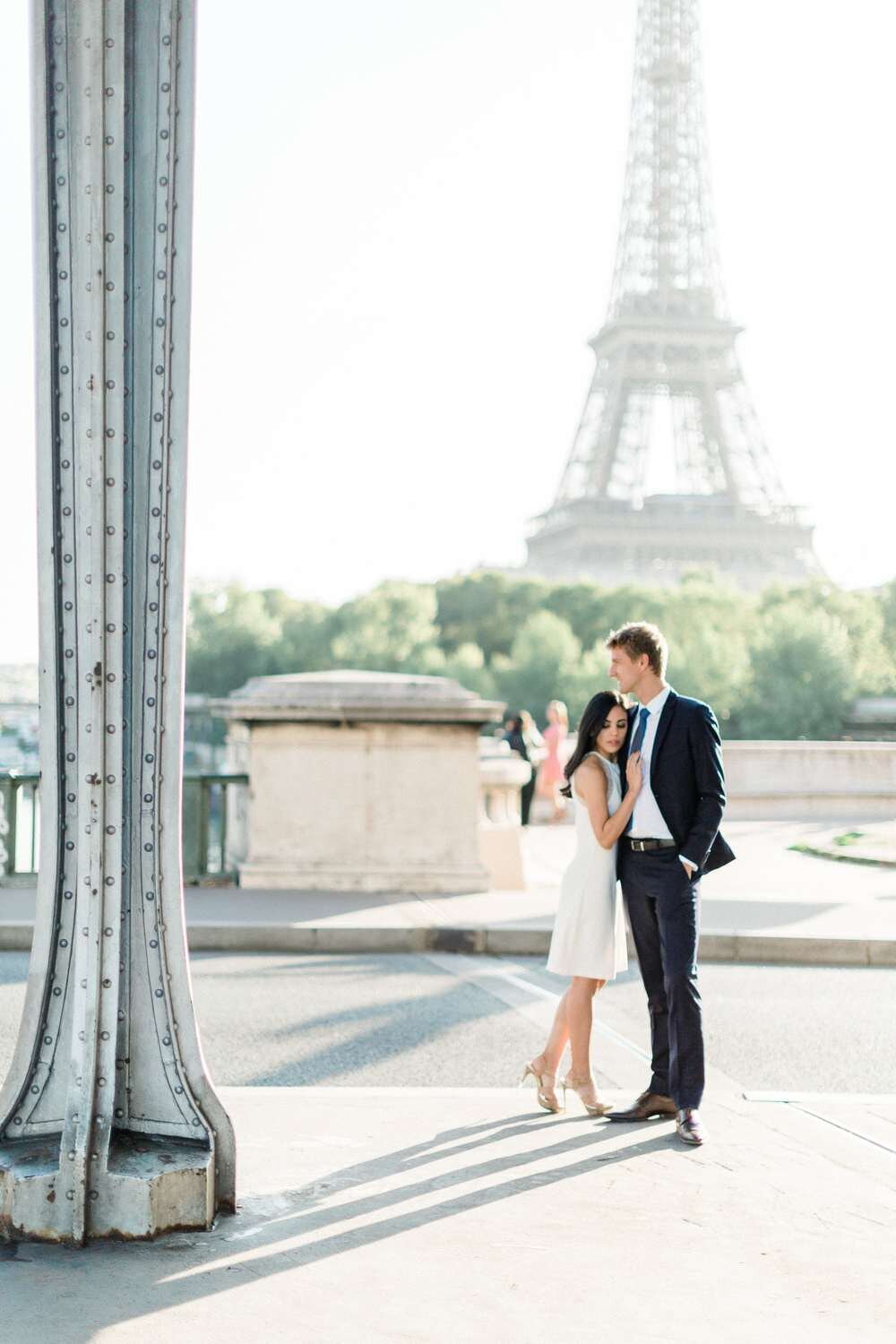
Every good image comes from a relationship between the people in front of the lens and the space around them. In Paris, that relationship is unusually productive. The architecture is scaled for photography. The light moves differently here. And certain corners of the city carry a graphic weight that transforms two people standing quietly into something that reads as a photograph before you even press the shutter.
Over years of working here, I have found locations that give back. Not just because they are beautiful. Because they create the conditions for an image to happen. Below are the seven locations I return to most for a couples photoshoot in Paris, and what each one actually does for a photograph.
The Louvre and the Richelieu Wing
There is a word I keep coming back to when I think about shooting at the Louvre: architecture as a verb. The building does something to the people inside it. The symmetry is relentless, the proportions are monumental, and the arches carry centuries of weight that has nothing to do with sentimentality.
When a couple stands inside that order, they stop being casual. The environment lifts them. They become still, the way statues are still. Not stiff, not posed. Still.
That quality does not happen by accident. You have to find the right time of day, the right angle. Early morning before the crowds settle in, or late afternoon when the light comes in low from the west. The Cour Carrée is one of the best large outdoor spaces in Paris for symmetrical work. The Richelieu passage, glassed over, fills with a gray-white light that is impossible to replicate anywhere else.
For a couples photoshoot in Paris where you want images with genuine architectural weight, the Louvre is the most demanding and the most rewarding location on this list.
The 6th and 7th Arrondissements
These two arrondissements form what I consider the most consistently photogenic district in Paris. Not because of any single monument. Because of a quality of living that shows up in the streets themselves.
The 6th is a writer’s neighborhood. Rue de Buci, Rue de Seine, the stretch around Saint-Germain-des-Prés. The buildings lean at angles that create compressed perspective. The signage is old. The light that falls through the plane trees onto limestone walls in October is a specific kind of gold that you cannot find in the 8th or the 16th.
The 7th is quieter, more residential, more graphic. Streets here are narrow in a way that concentrates everything. A couple walking toward you on Rue Saint-Dominique, half in shadow, becomes a frame within a frame without any deliberate composition. The neighborhood does the work.
What both arrondissements share is that they belong to people who know how to live in Paris. A couples photoshoot in this part of the city has a particular register. It is not touristy. It is not performative. It is Parisian in the way that means something.
The Tuileries Garden
The Tuileries is formal in the French sense. Gravel paths, clipped linden trees in long perspective lines, stone statues at regular intervals. A garden designed to be looked at as much as to be in.
That formality creates interesting possibilities. You are working with a space that already has strong geometry. The central allée creates depth. The pools reflect sky. In winter, when the trees are bare, the perspective lines become even more severe, and you can place two people at the far end of the long axis and understand immediately that they are in Paris, in this specific garden, in this light.
Autumn is the best season here. The trees hold their color through November. The morning light comes in from the east across the Seine and rakes across the gravel in a way that gives the ground texture. It is not a warm location. It does not invite closeness. But the images it produces have a quality of space and air that softer locations cannot give you.
The Quays of the Seine
The lower quays along the Left Bank, between Pont de la Tournelle and Pont de l’Alma, are arguably the most versatile stretch for a couples photoshoot in Paris. They work at every time of day. They work in every season. And they allow a kind of movement that more formal locations do not.
The stone walls backing the quays give you a textured surface that catches light evenly. The river gives you horizontal depth. The bridges give you framing. And the cobblestones give your images the specific ground texture that reads as Paris the moment you look at a photograph.
At sunset, the light on the Right Bank buildings across the water goes orange and then rose. On the lower quay, you are in shade. The contrast between the lit buildings behind and the couple in soft light is one of the most natural setups I know.
Early morning, the quays are often empty. Mist comes off the Seine in autumn. Nothing happens quickly at that hour, and that unhurried quality shows up in the photographs.
The Palais Royal Gardens
The Palais Royal is underused. Most visitors know the Buren columns in the courtyard. Far fewer walk through into the garden behind.
The garden is enclosed on four sides by the palace arcades. That enclosure does something acoustically and visually. It is quieter than it should be for the center of Paris. The arcades create corridors of column-and-shadow that give you precise, hard-edged geometry. The garden itself is planted in long rectangles with central fountains, and in late spring the lime trees are in flower.
The architecture here is slightly smaller in scale than the Louvre. More human. Two people walking under the arcades do not disappear into the space the way they might in the Cour Carrée. They fill it. That balance between human presence and architectural setting is what I look for when I choose this location.
For late afternoon work in spring and early summer, it is one of the best locations I know.
The Marais
The Marais asks for a different kind of photograph. Not architectural grandeur. Texture.
The streets here are medieval in their layout. The hôtels particuliers in the 3rd and 4th are some of the finest pre-Haussmann architecture in Paris, but they present themselves modestly. A cobbled inner courtyard glimpsed through an arched gate. A wall of pale stone with one long window. A narrow street where the upper floors nearly touch.
I come to the Marais for stone walls with character. For streets that frame rather than open. For the specific quality of light that falls in mid-afternoon into a courtyard facing south. The photographs produced here are less about scale and more about surface. Light on old stone. The weight of a hand against a wall that has been there since the 17th century.
The area around Place des Vosges works best in early morning, before the restaurants open. The arcade light is even and the square is quiet enough to work without an audience.
Pont des Arts and Pont Neuf
I treat these two bridges differently.
Pont des Arts is light. The metal lattice structure, the view onto the Ile de la Cité and the tip of the Louvre, the Seine moving below. It is a bridge that has been photographed endlessly, and the challenge is to work it in a way that does not repeat what already exists. I come here at blue hour or just after rain, when the reflections on the deck add depth to the frame.
Pont Neuf is something else entirely. It is the oldest bridge in Paris, and it looks it. The stone is worn, the low walls are carved with faces, the arches cut through to the water below. The tip of the Ile de la Cité at the Pont Neuf is perhaps the most purely cinematic view in Paris. Two people at the very prow of that island, with the river dividing on both sides and the city stretching in both directions.
I work Pont Neuf at golden hour when I can. The stone picks up the light well, and the perspective from the prow is irreplaceable.
What to Consider When Choosing a Location
Not every location works for every couple. Not every location works at every time of year.
A couples photoshoot in Paris works best when the location matches the register of the people in it. Formal architecture amplifies stillness and elegance. Street-level locations in the Marais or the 6th reward ease and natural movement. The Tuileries in winter needs two people who are not afraid of open space.
I ask about this before any session. What do you want the images to feel like? Where in Paris have you walked and felt most like yourselves? The answer usually points toward the right location faster than any list can.
The best sessions here have one thing in common. The couple arrives, looks at a corner of this city, and understands something about why they chose Paris. The photographs are the record of that understanding.
Frequently Asked Questions
What time of year is best for a couples photoshoot in Paris?
Late September through November gives the most reliable light. The summer crowds have thinned, the trees are turning, and the sun stays low enough to be useful throughout the afternoon. Spring in April and May is also strong, especially for locations with flowering trees. Winter works well for architectural locations like the Louvre and the Tuileries, where the stripped trees reveal the geometry.
What is the best time of day to shoot in Paris?
The two hours around golden hour, either morning or evening. Morning is generally less crowded and gives you softer, cooler light. Evening gives you the warm tones and the lit facades as the city transitions into night. Midday in summer is the hardest light to work with in Paris. The stone reflects white and the shadows are unforgiving.
How long does a couples photoshoot session in Paris typically take?
Most sessions run two to three hours. That gives time to move between two or three locations and to let the couple settle in. The first thirty minutes of any session are the warmest-up. The best images usually come from the second hour, once the formality of being photographed has worn off.
Do you need a permit to photograph at the Louvre or the Tuileries?
For personal portrait sessions in public spaces, no permit is required. The gardens of the Tuileries and the exterior spaces of the Louvre are public. Certain private courtyards and interiors require advance authorization. I handle any necessary logistics when they apply.
What should we wear for a couples photoshoot in Paris?
Think about the location and the season. The Louvre and the Palais Royal both read best with clothing that has some formality to it. The Marais and the Left Bank streets allow something more relaxed. Avoid very bright colors or heavy patterns that compete with the architecture. Neutrals, earthy tones, and dark solids all work well against limestone. Above all, wear something you have already worn before. Nothing stiff, nothing new. The photographs show when someone is uncomfortable in their clothes.







LEAVE A COMMENT