Most American couples who choose to marry in Paris aren’t running from something. They’re running toward everything at once. The architecture. The light on limestone at four in the afternoon. The restaurant where the waiter sets bread down without ceremony, and it’s the best bread you’ve ever eaten. Americans come to Paris because Paris holds, in one city, what an entire country hasn’t managed to produce. As a Paris wedding photographer who has worked with American couples across every arrondissement and beyond, I’ve noticed one thing consistently: they arrive already awake to it. They’re not tourists. They came to inhabit the place for a few days, and the photographs reflect exactly that.
There’s a specific quality to couples who choose Paris over a beach resort or a domestic estate. They’re not choosing convenience. They’re choosing the accumulated weight of a civilization that decided, over many centuries, that beauty was worth building toward. That choice shows in how they move through the day. It shows in the photographs.
What Paris Offers That You Can’t Find at Home
There’s an accumulation effect in Paris that has no real equivalent in the United States. It’s not one beautiful thing. It’s every beautiful thing, layered, built over centuries, occupying the same few square kilometers.
The architecture doesn’t behave the way American architecture does. Haussmann’s boulevards weren’t designed for efficiency — they were designed for the experience of moving through them. The proportions are deliberate. The ironwork on every balcony, the carved stone facades, the rhythm of windows and shutters: it’s a backdrop that was engineered to be looked at. No American city was built this way.
Then there’s the light. Paris sits at a northern latitude that produces a quality of afternoon light unlike what you get in California or Texas or Florida. Softer, more diffuse, slower to disappear. Golden hour in Paris extends. It lingers. Photographs made in that light carry a quality that’s genuinely difficult to replicate elsewhere.
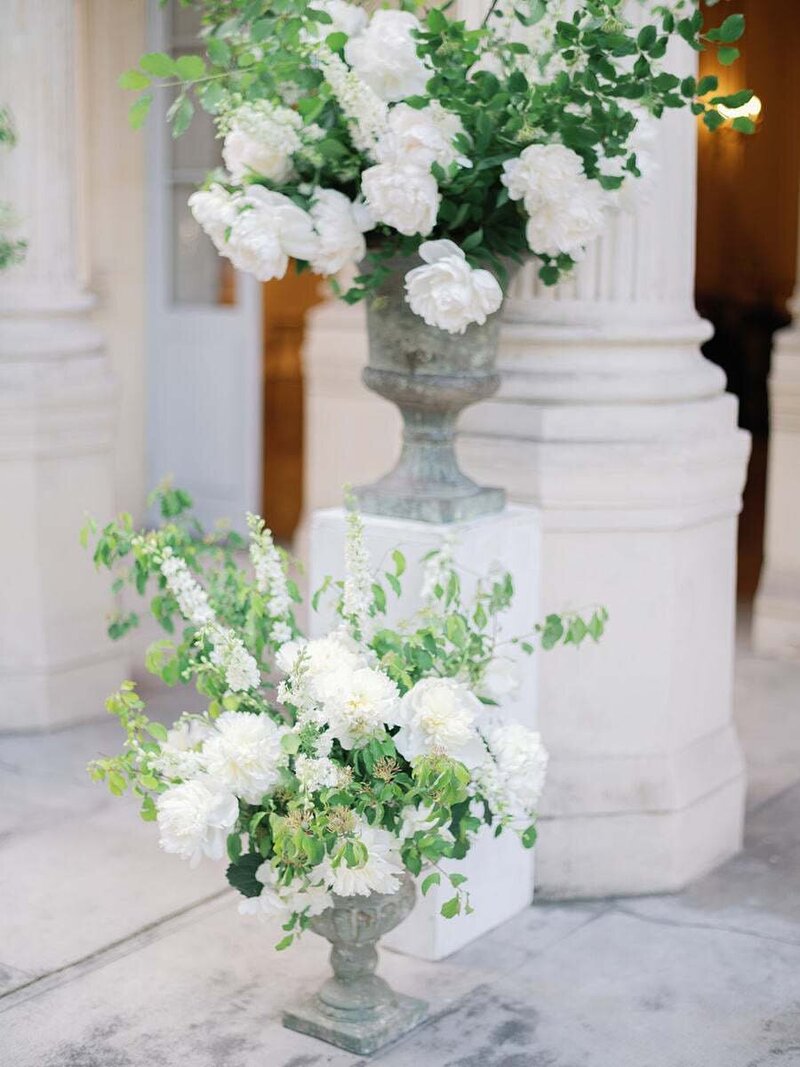
The fashion and aesthetic sensibility that French culture is known for worldwide — that’s not an abstraction. It’s visible in how people dress to walk to the market. It’s in the way a table is set in a bistro. It’s in the florist’s arrangement in the window, and the patisserie display, and the way a Parisian woman ties a scarf without thinking about it. All of that is in the background of your photographs. It enters every frame.
Gastronomy does the same thing. A dinner at a good Paris restaurant isn’t just a meal — it’s an aesthetic experience in the same register as the ceremony. The attention given to the table, the wine, the sequence of courses — it adds to the atmosphere that your photographer is working with all day.
For American couples, this accumulation lands differently than it does for Europeans who grew up surrounded by it. You see it clearly precisely because you didn’t grow up with it. The photographs show that clarity.
There’s also a way of existing in Paris that has no American equivalent. The French relationship to time at the table, the rhythm of a Sunday morning, the way the city slows down in August when the rest of the world accelerates — these aren’t tourist observations. They’re a fundamentally different tempo. American couples who come here for a wedding get a compressed version of that tempo. The day has more air in it. It moves differently. That difference is visible in the photographs of couples who let it in.
What this means practically is that the photographs made in Paris carry context. The city is not neutral. It has an opinion about beauty, about proportion, about what a street corner should look like and how a door should be hinged. When you put two people into that environment and step back, the photographs are already halfway there before I’ve pressed the shutter.
How a Paris Wedding Photographer Thinks About American Couples Specifically
Working with American couples in Paris requires understanding one thing from the start: you’re here because Paris gives you everything you couldn’t have at home. That means the photographs should reflect Paris — not just you in front of Paris.
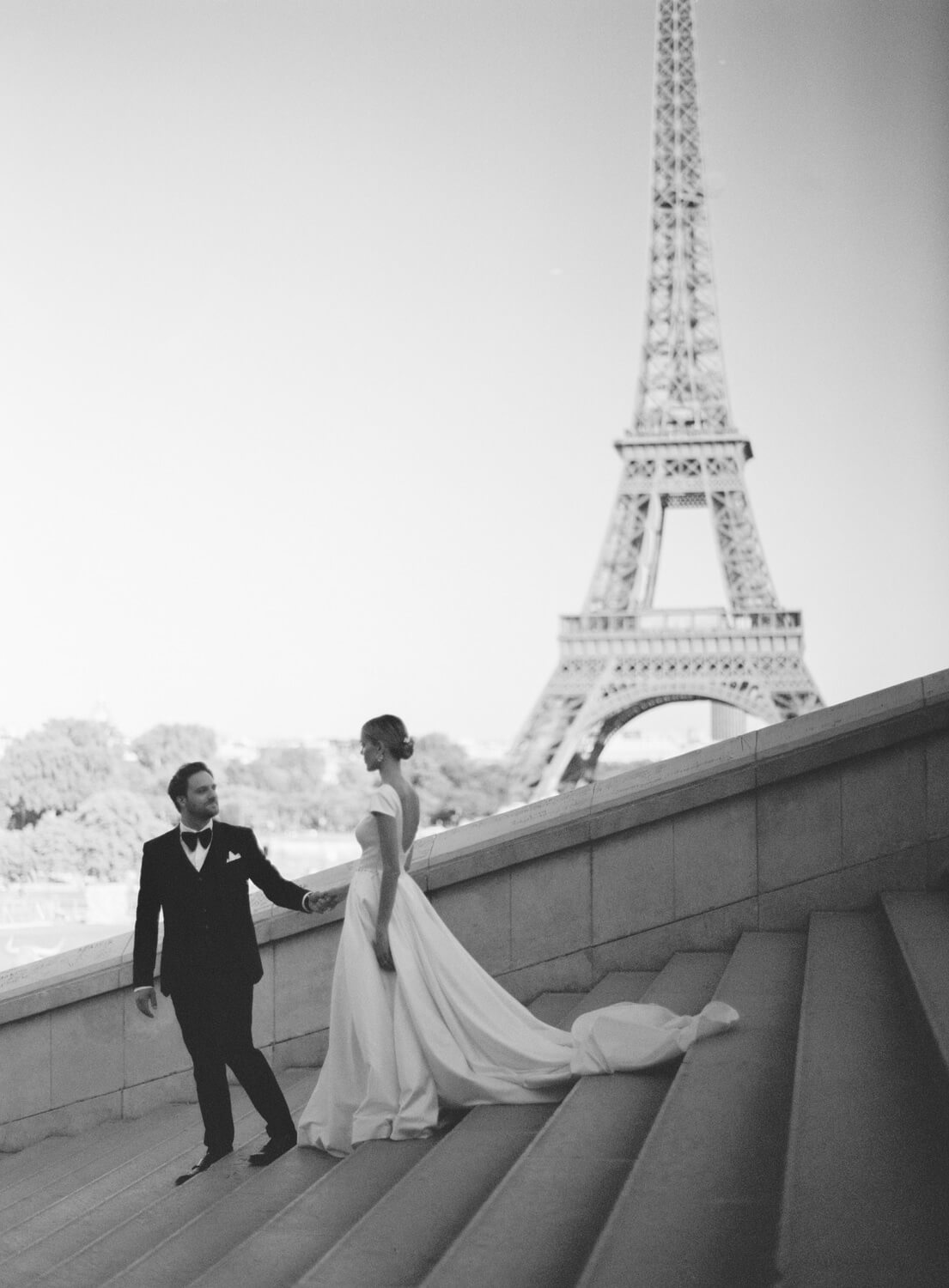
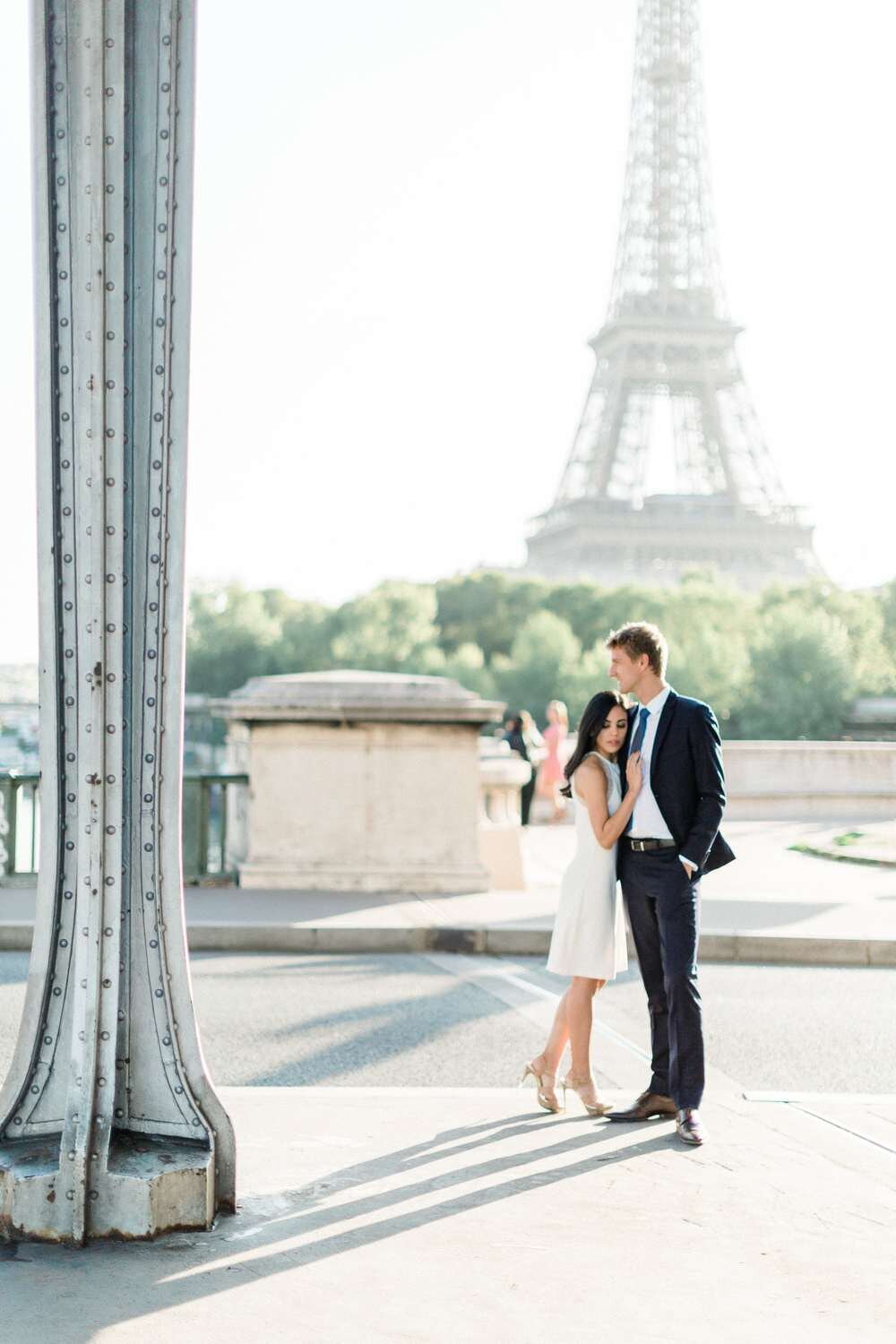
There’s a tendency, sometimes, to treat European destinations as a backdrop. To position people in front of the Eiffel Tower the way you’d position them in front of a green screen. That’s not what makes Paris photographs memorable. What makes them memorable is when the city enters the frame naturally — when the light, the stone, the geometry of a street or courtyard, the texture of the architecture — becomes part of how your day is described visually.
My approach is contemplative. I work with light and with place. I’m not chasing moments — I’m observing them. I’m attentive to when you stop looking at the camera and start looking at each other, or at the city, or at whatever is happening around you. That’s when the photographs become something other than records.
American couples who come to Paris are, in my experience, genuinely present. They’re not trying to get through the day. They’re living it. That attentiveness translates directly into photographs. The best images I’ve made of American couples here weren’t directed — they happened because the couple was actually inside the city, not performing for it.
The practical questions matter, too. You need a photographer who knows Paris well enough to work fluidly — to know which courtyard holds light until seven in the evening, which bridge is quieter, which streets near the Marais go quiet on a weekday afternoon. Local knowledge isn’t a bonus. It’s what makes the difference between a photograph that could have been taken anywhere and one that could only have been taken here.
There’s also the question of cultural fluency. American couples navigating French vendors, French timelines, French approaches to the unexpected — having a photographer who moves naturally between both worlds reduces friction. I can translate not just language but expectation. French vendors tend to be meticulous and slightly informal in their communication. That’s not disorganization. It’s a different professional rhythm. Knowing that, and communicating it clearly, keeps the day from accumulating small misreadings that add up to stress.
What couples consistently tell me afterward is that they felt less observed during the day than they expected to. That’s the goal. The photographs should feel like memory, not like documentation. Memory is selective, atmospheric, slightly compressed. It keeps the light and lets go of the logistics. That’s what I’m working toward in every frame.
Venues American Couples Choose in Paris
Paris works at every scale. Small ceremonies at the mairie. Church weddings at Saint-Germain-des-Pres or the American Cathedral. Garden receptions at private hotels particuliers in the 7th or the 16th. Receptions at storied venues along the Seine. Each requires different photographic thinking.
Hotel particuliers — the grand private townhouses of Paris — offer something that American reception venues rarely have: rooms that carry centuries of context. The patina of old wood floors, the proportions of tall windows, stone staircases, period detail that isn’t decorative but structural. It’s in the building itself. Photographs made in these spaces have weight.
Outdoor ceremonies in the Bois de Vincennes or at chateau gardens near Paris bring a different quality — that specifically French relationship to formal landscape design. Even the gardens are intentional. The geometry, the allees of trees, the controlled wildness of a French jardin — all of it provides a visual structure that photographs work with naturally.
For couples who want to include Paris itself as a location — not just as a backdrop for the reception venue, but as a subject — a session walking through the Palais Royal, the Marais, the streets behind the Odeon — that’s often where the most distinctive images of the day come from. Not the posed portraits. The photographs of you moving through a city that fits you.
A few neighborhoods deserve particular mention for what they give photographically. The 7th arrondissement around the Champ de Mars offers grand proportions without the crowds that collect near the tower itself. The Saint-Louis has a contained, village quality that reads beautifully in late afternoon. The streets south of the Palais Royal, through the 1st and into the 2nd, have a specific architectural density — passages couverts, courtyards, galleries — that photographs entirely differently from the open boulevards. Knowing where to be at what hour of the day is most of the work.
FAQ: Paris Weddings for American Couples
Do I need to speak French to plan a wedding in Paris?
No. Most venues that work with international couples have English-speaking coordinators. Wedding planners specializing in American couples in France handle the logistics that require French — vendor communication, administrative paperwork, permits. Your photographer should be fluent enough in both languages and both cultures to move easily between them.
How far in advance should I book a Paris wedding photographer?
For peak season — May through October — eighteen months ahead is standard for good photographers. Many preferred dates at top venues book out twelve to eighteen months in advance, and the photographer follows that timeline. Booking early also gives you time to communicate, review my work thoroughly, and make sure the aesthetic fit is right.
What’s the best time of year for natural light in Paris?
Late May through early July gives you the longest days and the softest evening light. September and October produce a particular quality of golden autumn light that photographs very well. Winter and early spring are underrated — the light is lower, more dramatic, and Paris is quieter. Each season has a different visual character. None of them is wrong.
Can we include a Paris portrait session as part of our wedding photography?
Yes, and I recommend it. A separate session — the morning after the wedding, or a day before — gives us time in the city without the schedule pressure of the wedding day itself. We can move at a slower pace, respond to what we find, and make photographs that are specifically about Paris rather than photographs that happen to have Paris in them.
How is working with a French photographer different from working with an American wedding photographer?
Partly it’s practical — I know the city, the light, the vendors, the streets. Partly it’s aesthetic — my references are European, my approach is more contemplative and less event-driven. But mostly it’s about presence. I work quietly. I don’t direct often. I’m watching for the photographs rather than engineering them. If you want a photographer who will orchestrate every moment, I’m not the right fit. If you want someone who will let Paris and your day produce the images, that’s what I do.







LEAVE A COMMENT