Paris is the most photographed city on earth. Thirty million tourists pass through it each year. On the Pont des Arts at noon, there is nowhere to stand. The Trocadero reflects light from thousands of phone screens. Every angle has been taken.
And yet. There is a Paris that exists before all of that. Before the crowds arrive, before the Parisians start their commute, before the day hardens into noise — Paris is something else entirely. I know this because I photograph there, and I photograph early. The couples who come to Paris with me do not get the postcard. They get the real thing: empty streets, soft September light, and two hours that belong entirely to them.
As a wedding photographer in Paris, this is the work I return to again and again. Not because I want to deliver something dramatic. Because Paris, in that light, at that hour, is genuinely one of the most beautiful places I have ever seen.
The Morning Light You Cannot Replicate
There is a quality to Paris morning light that does not appear at any other hour.
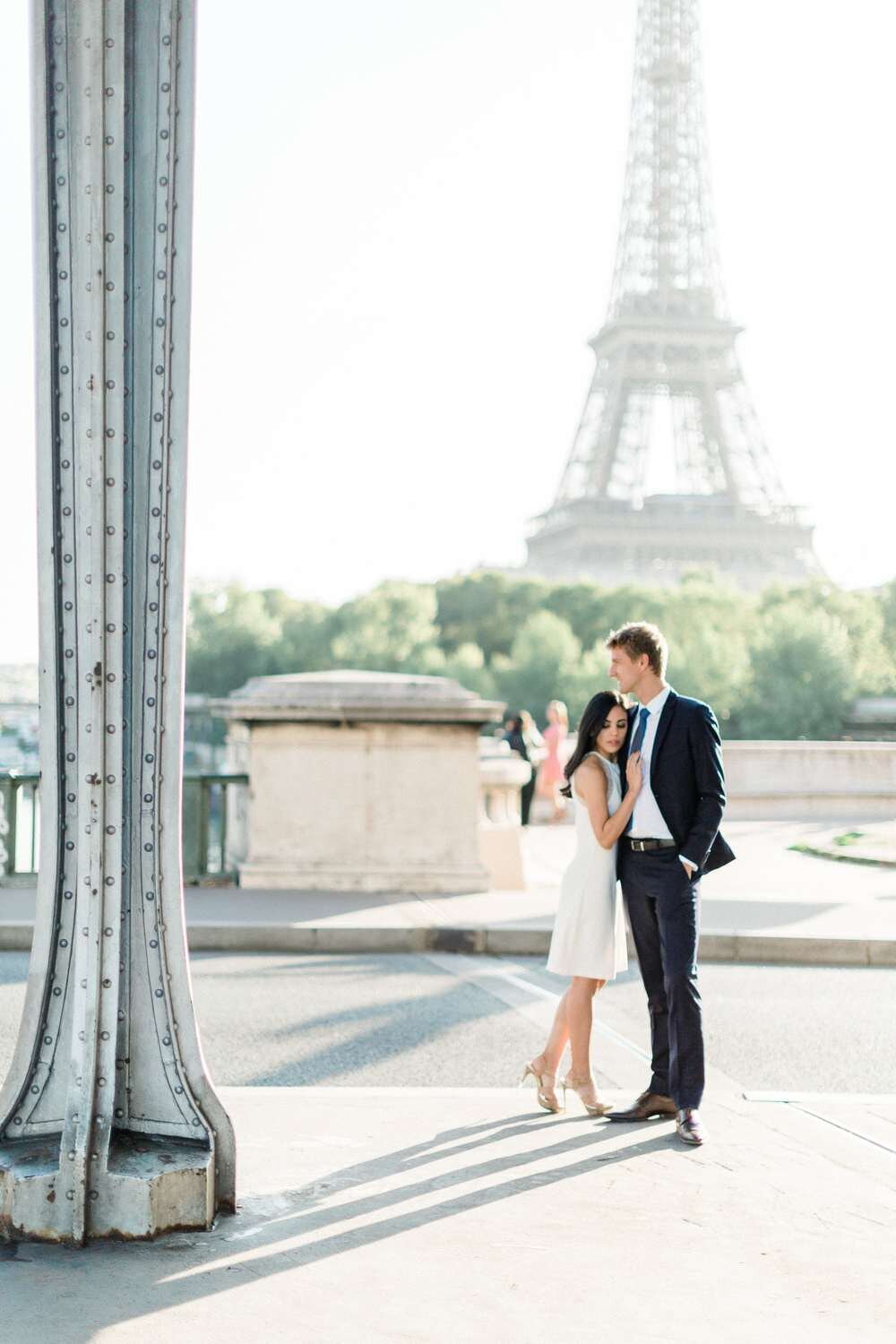
It comes low over the Seine before 8am, flat and even, with none of the contrast that midday forces onto every surface. Stone facades read as warm grey. Water moves slowly. Shadows fall long and clean across cobblestones. The sky above Île de la Cité holds a particular blue that no filter produces — it is simply there, for perhaps ninety minutes, and then it is gone.
I photograph in this light because it flatters everything it touches without effort. A dress photographed at 7:30am near the Pont Neuf has a different quality than the same dress at 2pm. The light does not compete with the subject. It supports it.
For couples who have chosen Paris as a destination — who have come from New York, from London, from Sydney — this light is part of what they came for, even if they have not named it yet. My job is to put them inside it. The rest follows.
The Paradox of the Most Visited City in the World
Paris receives more tourists than any city in the world. This is a fact that most photographers treat as a problem to solve — finding hidden corners, waiting for gaps in foot traffic, cropping strangers out of the frame.
I see it differently.
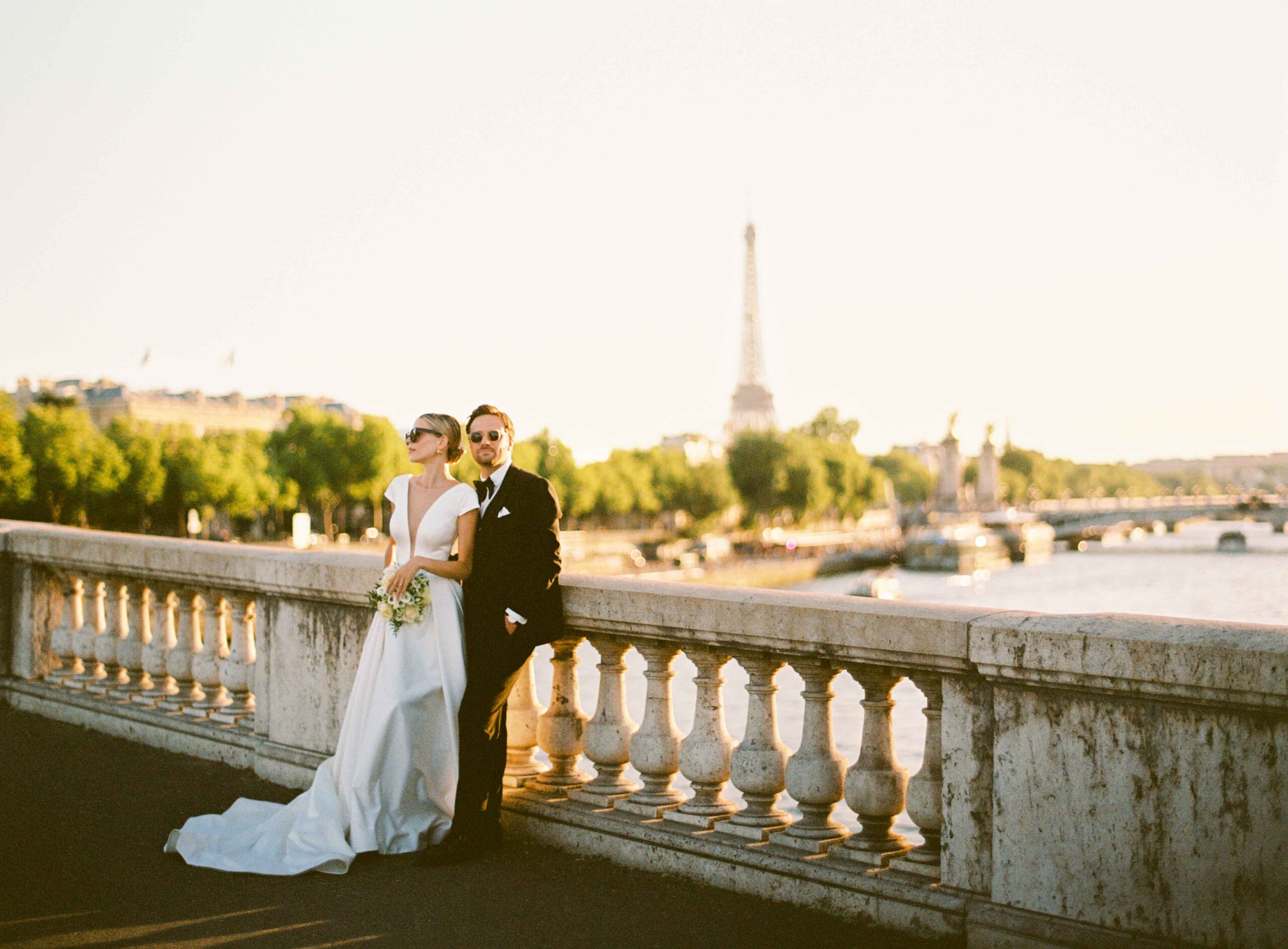
The extraordinary thing about Paris is not that it is visited. It is that, despite everything, there are still moments when it is empty. When the light is right and the hour is right, a couple can stand alone on the Pont Alexandre III, with no one behind them and the Grand Palais ahead, and the city is theirs. Not performed for them — actually theirs. The silence is real. The scale of the architecture is real. The light on the water is real.
This is the paradox that interests me as a wedding photographer in Paris. A city of thirty million visitors, and yet two people can have it entirely to themselves. It takes knowing when to arrive. It takes being willing to set the alarm.
The couples I work with understand this. They do not want a busy backdrop. They want the place. The real place, at the hour when it gives itself over to you.
Where I Work in Paris
I return to certain places because they respond well to morning light. Not because they are Instagram locations — some of them are, some are not — but because the combination of architecture, scale, and available light produces photographs that hold up.
The Palais Royal at 6:45am, before the cafes open their chairs: the colonnades cast long parallel shadows and the garden is entirely still. The light is pure and even.
The quais along the left bank, from the Pont de la Tournelle west toward the Pont des Arts: the walk is long but the light on Notre-Dame and the water changes every ten minutes. Nothing is static.
Montmartre on a Tuesday in October, before the vendors arrive: the city spreads below and the light comes from the east. The Sacré-Coeur needs no enhancement.
The Marais, early: narrow streets, irregular facades, unexpected geometry. A couple walking toward you with the morning light behind them, the street empty ahead, the stone walls warm from the previous day’s heat.
None of these require tricks. They require presence and timing. Being there before anyone else decides they need to be there too.
I also photograph wedding days throughout Paris — at the town halls, at private venues, in the parks, at the reception tables when the candles are lit and the noise has dropped to something quieter. The morning session is a separate thing, often the day before or after the wedding itself. It is not obligatory. But couples who have done it tell me it was the two hours they remember most clearly.
Paris on a Wedding Day
The morning session is one thing. A full wedding day in Paris is another.
Paris weddings follow their own rhythm. The ceremony at a mairie, the narrow staircase, the waiting room with its high ceilings and municipal light. Then the move through the city — on foot, by car, across bridges — to wherever the celebration continues. Private courtyards in the 6th. Rooftop terraces in the 11th. Historic salons on the Île Saint-Louis, where the ceiling height alone changes the quality of everything you see.
I photograph the day as it moves. The hour before the ceremony, when the getting-ready is nearly done and the nervousness has settled into something quieter. The moment on the street when the two of you first see each other, surrounded by people who know you, in a city that does not. The meal, mid-afternoon, when the light through the tall windows goes warm and horizontal and the table holds every element you need — glasses, flowers, faces, gesture.
I am not directing continuously. I am watching continuously. These are different things.
By the end of a Paris wedding day, the light has moved through four or five phases. I follow it. The photographs from the end of the evening, when the candles are the only source, have a quality that midday cannot produce. The whole arc of a day, in one of the world’s great cities, is worth documenting carefully.
What to Expect When We Work Together in Paris
I do not produce photographic styles. I do not run a studio that outputs a formula.
What I bring to every session in Paris is the same thing: an eye shaped by years of looking at this city, at its light, at the scale of its buildings against the sky, at the way two people occupy space together. I photograph what I see. Nothing forced. Nothing decorative.
For destination couples visiting Paris for their elopement, wedding, or a portrait session, here is how it typically works.
We meet early. Usually 6:30 or 7am depending on the season and the light. You do not need to be dressed for a shoot — you need to be dressed for Paris in the morning. Comfortable shoes matter. We walk. I direct when it helps and step back when it does not. Most of what happens is conversation and observation. I am not setting scenes. I am watching for the moments when the light, the place, and the two of you come together.
We work for roughly two hours. Some days three. The light changes fast in the early morning and there is a window that closes. Within that window, we move through two or three locations depending on what the day offers.
The selection process takes time. I do not deliver volume. You receive a curated gallery — the photographs that hold, that say something, that you will still want to look at in ten years. The ones that looked good in the moment but do not sustain that quality over time, I do not include.
You receive the photographs within eight weeks. No rush delivery fees, no hidden tiers. The work is the same regardless of what you have booked.
FAQ: Wedding Photography in Paris
How far in advance should I book?
I take a limited number of sessions each year in Paris. For spring and autumn dates — which are the seasons with the most consistent morning light — the calendar fills between six and twelve months ahead. If you have a specific date in mind, the earlier you reach out, the better.
Do you work on the wedding day itself, or only portrait sessions?
Both. I photograph full wedding days in Paris and across France, and I also work with couples who are coming to Paris specifically for a portrait session around their wedding. Some couples book me for the portrait session only; others book me for the full day. There is no requirement to combine them.
What happens if the weather is poor?
Paris in overcast light is still Paris. A flat sky removes the harsh shadows of a sunny day and often produces a more even, sustained quality of light. I have photographed in rain, in fog, in the kind of October morning that feels like it belongs to another century. The sessions I remember most clearly are not always the ones with perfect weather.
Can we photograph at specific venues or monuments?
Most exterior locations in Paris are freely accessible. Interior shoots at certain monuments or private venues require permits, which I can assist with. The main considerations are logistical — access hours, permit lead times, the locations that reward early arrival versus those that do not. We discuss this when planning together.
What makes you different from other photographers working in Paris?
I am not the right photographer for everyone, and I do not try to be. I photograph beauty before I photograph emotion. I am more interested in light and place and stillness than in expressions and reactions. If you are looking for a wedding photographer in Paris who will direct you through forty poses and deliver a high-volume gallery, I am probably not the right fit.
If you want photographs that say something about Paris as it actually is — the stone, the light, the geometry, the particular quality of a city that has been looked at for centuries and still has something to offer at 7am — then we may be looking for the same thing.







LEAVE A COMMENT